


Uncompromising leader Khaleda Zia no more
Published:
৩০ ডিসেম্বর ২০২৫, ১০:৫৩
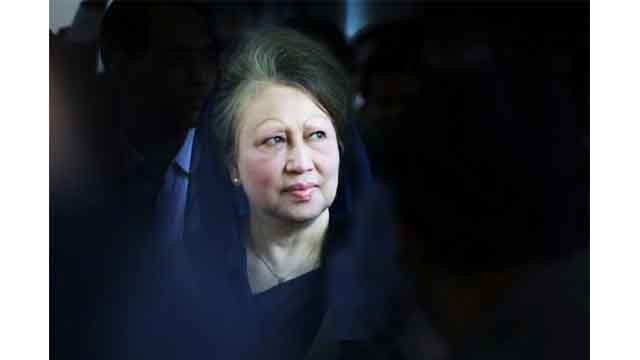
The uncompromising leader, BNP Chairperson and former Prime Minister Begum Khaleda Zia, has passed away. (Inna lillahi wa inna ilaihi raji’un.)
She died at 6:00 am on Tuesday, 30 December, according to a post on the BNP Media Cell’s Facebook page.
A verified post on BNP’s official Facebook page confirmed that Begum Khaleda Zia passed away shortly after the Fajr prayer. The post read: “We pray for the forgiveness of her soul and request everyone to offer prayers for the departed soul of our Chairperson and former Prime Minister Begum Khaleda Zia. Inna lillahi wa inna ilaihi raji’un.”
BNP’s Press Wing also informed that her personal physician and BNP National Standing Committee member, Dr AZM Zahid Hossain, confirmed her death.
The statement further mentioned that at the time of her death at Evercare Hospital, Begum Khaleda Zia’s eldest son and BNP Acting Chairman Tarique Rahman, his wife Dr. Zubaida Rahman, granddaughter Zaima Rahman, her younger daughter-in-law Sharmila Rahman Sithi, her elder sister Selina Islam, her younger brother Shamim Iskander were present.
Additionally, BNP Secretary General Mirza Fakhrul Islam Alamgir and all members of the medical board overseeing her treatment were present.
Begum Khaleda Zia had been suffering from several chronic health conditions, including heart disease, diabetes, arthritis, liver cirrhosis, and kidney complications. She was admitted to Evercare Hospital on 23 November after experiencing breathing difficulties. Her treatment was overseen by a medical board comprising local and international specialists. Plans had been made to send her abroad for treatment, but her condition did not permit it.
Begum Khaleda Zia was the Chairperson of the Bangladesh Nationalist Party (BNP) and served as the Prime Minister of Bangladesh three times since 1991. She was the country’s first female Prime Minister and the second elected female head of government in the Muslim world.
Begum Zia held a unique record in Bangladesh’s political history, having never lost any parliamentary election she contested. Between 1991 and 2001, she was elected from five different constituencies in general elections, and in the 2008 election, she won all three constituencies she contested.
Born in Dinajpur in 1945, Khaleda initially attended Dinajpur Missionary School and later completed her matriculation from Dinajpur Girls' School in 1960.
Khaleda's father Iskandar Mazumder was a businessman and mother Tayeba Mazumder was a housewife. Nicknamed "Putul", Khaleda was the second among three sisters and two brothers.
In 1960, she married Ziaur Rahman, who later became a 1971 liberation war hero and President of Bangladesh. As First Lady, she accompanied him on various state visits and met world leaders including UK Prime Minister Margaret Thatcher and Queen Juliana of the Netherlands.
After the assassination of President and BNP founder Ziaur Rahman in Chittagong on 30 May 1981, Khaleda Zia, along with her two children, stayed at Dhaka Cantonment while the BNP faced a leadership crisis.
She formally joined BNP on 2 January 1982 as a founding member, and due to her political acumen, she was quickly elected senior vice-chairperson.
On 12 January 1984, she became acting chairperson, and on 10 May 1984, she was elected chairperson unopposed. She was subsequently re-elected in the party councils of 1993, 2009, and 2016.
During her leadership, Khaleda Zia faced numerous challenges. She united the party to lead mass movements against the autocratic rule of Hussain Muhammad Ershad without compromising on principles.
Her efforts helped topple Ershad, and in the 27 February 1991 elections, BNP secured a parliamentary majority.
She first became Prime Minister in 1991, served again in 1996, and was elected for a third term in 2001 through a coalition government.
She also served twice as Chairperson of the SAARC. She holds a unique record in electoral history, having contested 23 seats in five national elections and winning all of them.
On 3 September 2007, during the military-backed caretaker government of the “One-Eleven” period, she was arrested. After a prolonged period in custody, she was granted bail in all cases. Although attempts were made to send her abroad while she was in prison, she did not leave the country.
After the Awami League returned to power on 13 November 2010, she was evicted from her cantonment residence, where she had lived for 28 years. The house had been allocated to her by then-President Abdus Sattar following the assassination of Ziaur Rahman.
Since entering politics, she became an uncompromising leader of anti-autocracy movements. She was arrested during movements against Ershad on 28 November 1983, 3 May 1984, and 11 November 1987, and faced another wave of arrests during the One-Eleven caretaker government. Despite pressure to leave the country, she remained in Bangladesh.
Her entire political journey stands as a symbol of steadfastness, resilience, and struggle. For this reason, Khaleda Zia has become an enduring symbol of relentless political struggle in Bangladesh.

Comment: