


Government employees are not allowed to take sides
Published:
২৮ জানুয়ারী ২০২৬, ১১:৪৮
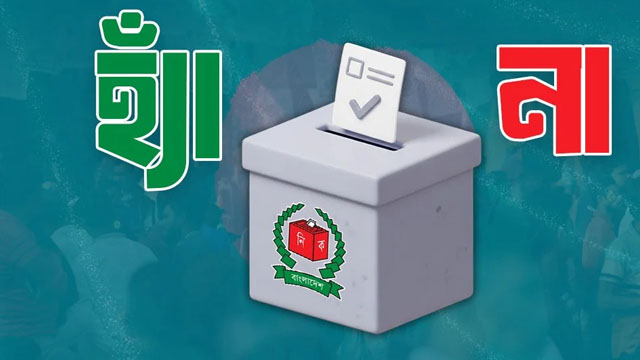
Ahead of the national parliamentary election scheduled for 12 February, government officials and employees will not be allowed to take sides in the accompanying referendum. Campaigning in favour of either “Yes” or “No” will constitute a punishable offence, two Election Commissioners said on Tuesday, citing relevant provisions of the Representation of the People Order (RPO) 1972 and the Referendum Ordinance.
They said the prohibition applies not only to officials directly involved in polling, but also to any government officers or employees who attempt to influence the referendum outcome; such acts would be treated as punishable offences.
Government employees barred from taking sides
Election Commissioner Abdur Rahmanel Masud said on Tuesday evening, “Under the law, I say emphatically that there is no problem in explaining what proposals are included in the referendum campaign. The Election Commission itself is doing that—explaining how to vote and what kind of ballot will be used—to build awareness about the referendum.
“But returning officers, assistant returning officers, presiding and polling officers, as well as any government officials or employees, cannot say they support ‘Yes’ or oppose with ‘No’. This is strictly prohibited.”
He added, “You may ask why advisers are campaigning for ‘Yes’. Advisers are not government servants; they are public servants, not employees of the republic. Therefore, advisers may campaign for ‘Yes’ in the referendum. They themselves have spent considerable resources for the nation to take this initiative. That is the reality. But government officials and employees cannot do so. It is not just prohibited—campaigning for or against ‘Yes’ or ‘No’ is a punishable offence for them.”
Asked whether the Election Commission has issued any directive on the matter, Masud said, “We have just discussed this within the Commission. We may issue a circular, but we are also informing relevant parties in various ways. I recently visited Chattogram and informed the district administration of the legal position. By speaking to the media, we want you to help publicise these rules. Even if we do not issue a circular, the law is already in force.”
He further said that Article 86 of the RPO 1972 and Section 21 of the Referendum Ordinance (Offences, Penalties and Trial Procedure) clearly state that if government officials or employees attempt to influence election results, it is not only an offence but a punishable offence.
Article 86 of the RPO 1972 states that if any person employed in the service of the republic abuses official position to influence election results, they shall be guilty of a punishable offence, liable to imprisonment for not less than one year and up to five years, along with a fine.
Section 21 of the Referendum Ordinance provides that acts considered offences or violations of the electoral code of conduct under the RPO 1972 shall, as applicable, also be deemed offences or violations in the case of a referendum, and appropriate legal action may be taken by the competent authority.
Another Election Commissioner, Anwarul Islam Sarkar, told journalists at the Election Commission building that officials performing election duties may conduct awareness campaigns for the referendum, but they cannot campaign in favour of or against “Yes” or “No”. Asked about the Commission’s position, he said, “We are encouraging voters to participate in the referendum. Those entrusted with election duties are legally barred from taking sides.”
Responding to questions about government agencies and officials campaigning for “Yes”, he declined to comment, adding that the Commission, as a constitutional body, is working independently.
Despite the Commission’s stance, campaigns supporting “Yes” are reportedly being carried out by various government institutions, with billboards, banners and festoons displayed on government buildings. The advisory council has argued that there is no legal bar on government officials campaigning for “Yes”, claiming existing laws do not prohibit republic employees from supporting positive change, and citing international precedents where governments have campaigned for “Yes” in referendums.
Expert opinions
Constitutional expert and senior Supreme Court lawyer Dr Shahdeen Malik said advisers of the interim government also appear to be barred from campaigning for “Yes”, as they are not outside the republic. He argued that the same restrictions applicable to government officials should apply to advisers at ministerial level, and that the ongoing campaigns by government institutions conflict with existing laws.
Election expert and member of the Electoral System Reform Commission Begum Jasmine Tuli said the referendum law should have clearly defined what types of campaigning are allowed or prohibited. Under existing laws, she said, government officials and employees cannot campaign for either side, and the Election Commission should have clarified this earlier.
Four issues, one answer: ‘Yes’ or ‘No’
The referendum will cover four issues, with voters expressing their opinion by casting a single “Yes” or “No” vote through secret ballot. The issues include: formation of caretaker and constitutional bodies during elections under the July Charter process; establishment of a bicameral parliament with a 100-member upper house elected proportionally; implementation of 30 reform proposals agreed in the July National Charter; and implementation of other reforms outlined in the Charter.
On referendum day, voters will cast a secret ballot to answer “Yes” or “No” to the single combined question.

Comment: