


Can NCP progress while remaining aligned with Jamaat?
Published:
৯ মে ২০২৬, ১৫:৪৭
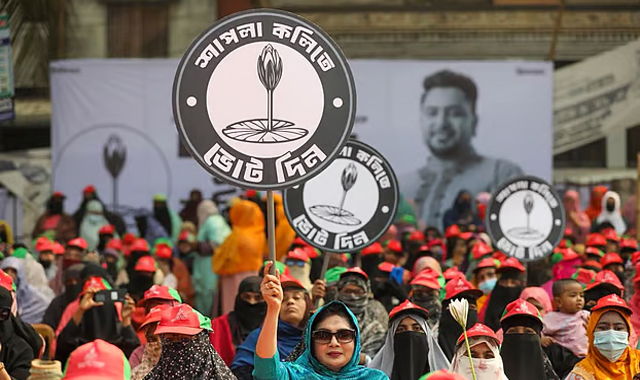
The National Citizen Party (NCP), formed through the July mass uprising, had raised hopes among many. However, ahead of the election, the party faced an internal crisis over forming an alliance with Jamaat-e-Islami.
Several leaders also left the party. Questions later emerged during NCP meetings about how long the alliance with Jamaat would continue after the election. So far, however, indications suggest that the NCP intends to continue alongside Jamaat.
Party leaders argue that the NCP has not yet developed the organisational strength necessary to operate independently within just one year. That, in turn, has raised another question: can the NCP establish a distinct political identity in this way?
Discussions with NCP leaders revealed that the party wants to build a broader movement to implement the referendum mandate. However, leaders believe the party currently lacks the organisational capacity to carry out such a movement alone.
For that reason, the NCP wants to remain within the Jamaat-led 11-party alliance, intensify the movement, and increase pressure on the ruling Bangladesh Nationalist Party (BNP).
NCP senior joint convener Ariful Islam Adeeb told Prothom Alo, “Implementing the referendum mandate and the July Charter through party programmes and through the 11-party alliance by building a mass movement is now the NCP’s priority. The full implementation of the July Charter is essential to prevent the resurgence of a fascist system.”
Following the removal of the Awami League government during the July mass uprising, political parties held discussions with the interim government that later produced the July National Charter aimed at reforming the state structure.
The 11-party alliance alleges that the BNP, after assuming power, has moved away from implementing that charter. As a result, the alliance wants to continue pressuring the BNP.
In addition, the NCP plans to contest the upcoming local government elections as part of the alliance. The party’s policymakers believe local government elections provide an effective opportunity to expand the organisation at the grassroots level.
They think the party can strengthen its organisational foundation if it succeeds in electing a significant number of candidates to union councils, upazila councils, municipalities, and city corporations across the country.
Three senior NCP leaders, including two members of parliament, spoke about this strategy on condition of anonymity. They said the NCP’s principal political commitment is reforming the state system to eliminate fascism.
The NCP wants to remain within the Jamaat-led 11-party alliance, intensify the movement, and increase pressure on the ruling Bangladesh Nationalist Party (BNP).
However, without expanding the party organisation, the NCP cannot pursue that objective in the long term. Yet the party’s organisational strength has still not reached the expected level. As a result, the NCP has, in many ways, become compelled to engage in alliance politics.
Before the 13th National Parliamentary Election, a section of the NCP objected to forming an alliance with Jamaat. However, a larger section supported the alliance. Subsequently, at least 17 central leaders resigned from the party, while several others became inactive in politics.
Despite the internal backlash, NCP policymakers remained firm on contesting the election as part of the Jamaat-led alliance. A number of 30 NCP candidates contested the election as nominees of the 11-party alliance.
Among them, party convener Nahid Islam, member secretary Akhtar Hossen, and four others won seats and now serve in parliament.
Implementing the referendum mandate and the July Charter through party programmes and through the 11-party alliance by building a mass movement is now the NCP’s priority. The full implementation of the July Charter is essential to prevent the resurgence of a fascist system.Ariful Islam Adib, NCP senior joint convener
Will the party retain its distinct identity?
Reports suggest that a section of the NCP’s current leadership also opposes remaining allied with Jamaat. However, that faction appears to hold limited influence within the party.
Many people outside the party also regularly criticise the NCP for remaining in the alliance. Critics question whether the NCP can establish itself as an independent political force while staying aligned with Jamaat.
Some also frequently criticise the party on social media by highlighting that a section of NCP leaders was once involved with the politics of Islami Chhatra Shibir, the student wing of Jamaat-e-Islami.
Abdul Kader, who served as a coordinator of the Anti-Discrimination Student Movement during the July mass uprising and gained prominence after announcing the nine-point demands, is among the strongest critics of the NCP’s alliance with Jamaat.
In a Facebook post on 22 April, he wrote, “If the NCP becomes a party outwardly but a ‘proxy wing’ internally, then what future does the NCP have as a political party?”
However, according to a senior NCP leader, the ideologies of the NCP and Jamaat differ significantly.
He said the party has had to engage in alliance politics because it has not yet developed sufficient organisational capacity. He also noted that, at present, the Jamaat-led alliance remains the most active political party opposing the BNP.
NCP leaders despite remaining in the alliance, sought to explain that the party’s fundamental principles differ from those of Jamaat. On 9 April, they presented their position in parliament on a particular issue.
On that day, parliament introduced a bill to convert the Jatiyo Muktijoddha Council (Jamuka) Ordinance into law while retaining the names of the then Muslim League, Jamaat-e-Islami, and Nezam-e-Islam Party as collaborators of the Pakistani occupation forces during the Liberation War.
Although Jamaat objected to the bill, the NCP stated that it had no objection to the proposed legislation.
In addition, the NCP is trying to bring back those leaders and activists who resigned from the party over the alliance with Jamaat.
Regarding the matter, Ariful Islam Adeeb, a member of the NCP’s highest policymaking body, the political council, said that party leaders are maintaining communication and holding discussions with those who resigned in an effort to persuade them to return.
However, there has so far been no indication that any former member is preparing to rejoin the party.

Comment: