


‘Disappeared victims branded as militants, later shown arrested’
Published:
১৯ জুন ২০২৫, ১৬:২৬
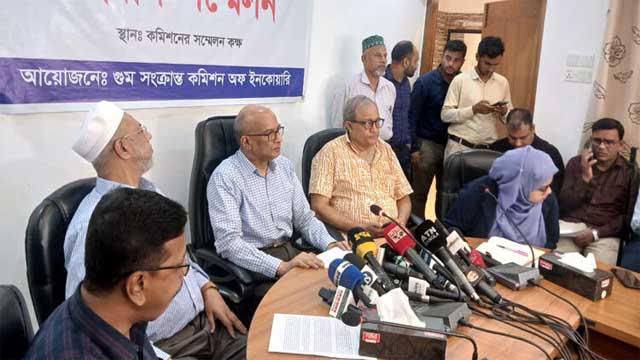
Many victims of enforced disappearance during the previous government’s tenure were branded as militants and later shown arrested in ongoing or newly filed criminal cases, according to Justice Moinul Islam Chowdhury, Chairman of the Inquiry Commission on Enforced Disappearances.
He stated that victims of enforced disappearance faced four possible outcomes. “Some were killed. Others were paraded before the media prior to trial—often labeled as militants—and shown arrested in ongoing or newly filed cases. In some instances, victims were taken across the border and handed over to Indian law enforcement. A fortunate few were released without being implicated in any case,” he said.
Justice Moinul shared these findings at a press conference held in Dhaka’s Gulshan on Thursday (June 19), based on an analysis of complaints received by the commission.
He further noted that on June 4, the commission submitted its second interim report to the Chief Adviser. “In that report, we highlighted that, during the tenure of the previous authoritarian government, enforced disappearances were systematically used as a tool to suppress opposition political forces and dissenting voices,” he added.
He said the interim report presented information on 253 victims of enforced disappearance, selected from an analysis of nearly 1,850 complaints. These 253 individuals share three common characteristics.
“First, there is contemporaneous evidence—such as general diary entries filed by family members at the time of disappearance, criminal cases, or news reports published during the period they went missing. Only these 253 victims were able to provide such contemporaneous evidence, while others could not, as police stations often refused to accept general diary entries in such cases at the time,” he noted.
“Second, when these victims reappeared from disappearance, they were shown arrested in anti-terror or other criminal cases—meaning a state agency acknowledged the individual was in its custody. Third, since these victims are alive, they could inform the commission that they were held in secret detention facilities under state custody, where many saw each other and endured similar forms of torture,” added Moinul Islam.

Comment: