
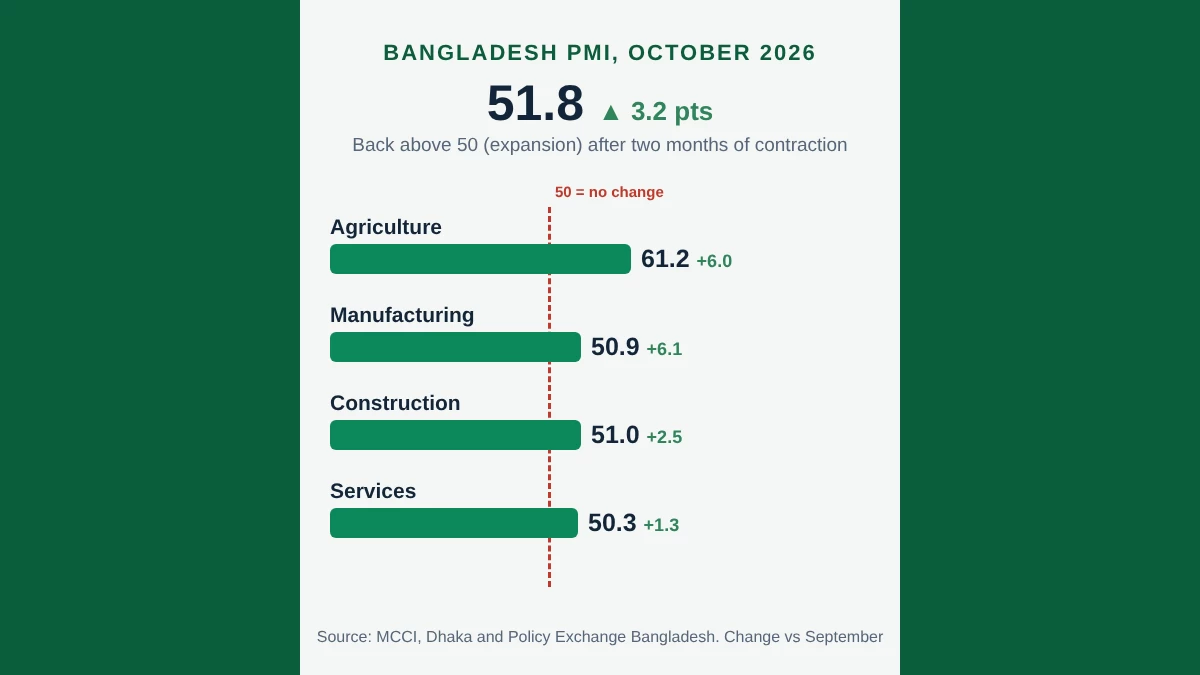
Bangladesh’s economic activity returned to expansion in October after two consecutive months of contraction. The overall Purchasing Managers’ Index (PMI) rose 3.2 points to 51.8, driven by stronger agricultural performance and a recovery in manufacturing, construction and services.
The Metropolitan Chamber of Commerce and Industry (MCCI), Dhaka and Policy Exchange Bangladesh jointly released the October reading on Monday (November 9). It showed expansion across all four key sectors. Demand-related indicators remained weak in several sectors, and business costs continued to rise.
Agriculture expanded for the 14th consecutive month. Its PMI rose 6 points to 61.2, indicating faster growth. New business, business activity and employment continued to expand, and the order backlogs index returned to expansion. Input costs continued to rise.
The manufacturing PMI climbed 6.1 points to 50.9. Stocks of input purchases, finished goods and imports returned to expansion, while employment and supplier deliveries continued to grow. New orders, new export orders and factory output remained in contraction, and the order backlogs index continued to show sharp contraction. Input prices recorded strong expansion, indicating persistent cost pressures.
The construction PMI rose 2.5 points to 51.0. Employment recovered to expansion after remaining unchanged in September, and order backlogs continued to grow. New business and construction activity remained in contraction, while input costs recorded strong expansion.
The services PMI increased 1.3 points to 50.3. Employment recovered, but new business, business activity and order backlogs continued to contract. Input costs in the sector remained under strong upward pressure.
The Future Business Index recorded expansion across all four sectors, indicating positive expectations about future business conditions.
M Masrur Reaz, chairman and CEO of Policy Exchange Bangladesh, described the return to expansion as a small but positive development after two difficult months. He said it was supported particularly by stronger agricultural and export performance.
He cautioned that the recovery remained fragile, as new orders and business activity continued to shrink in manufacturing, construction and services, while input costs remained elevated.
“The divergence suggests that the return to expansion has yet to translate into a broad-based strengthening of demand,” Masrur said.