
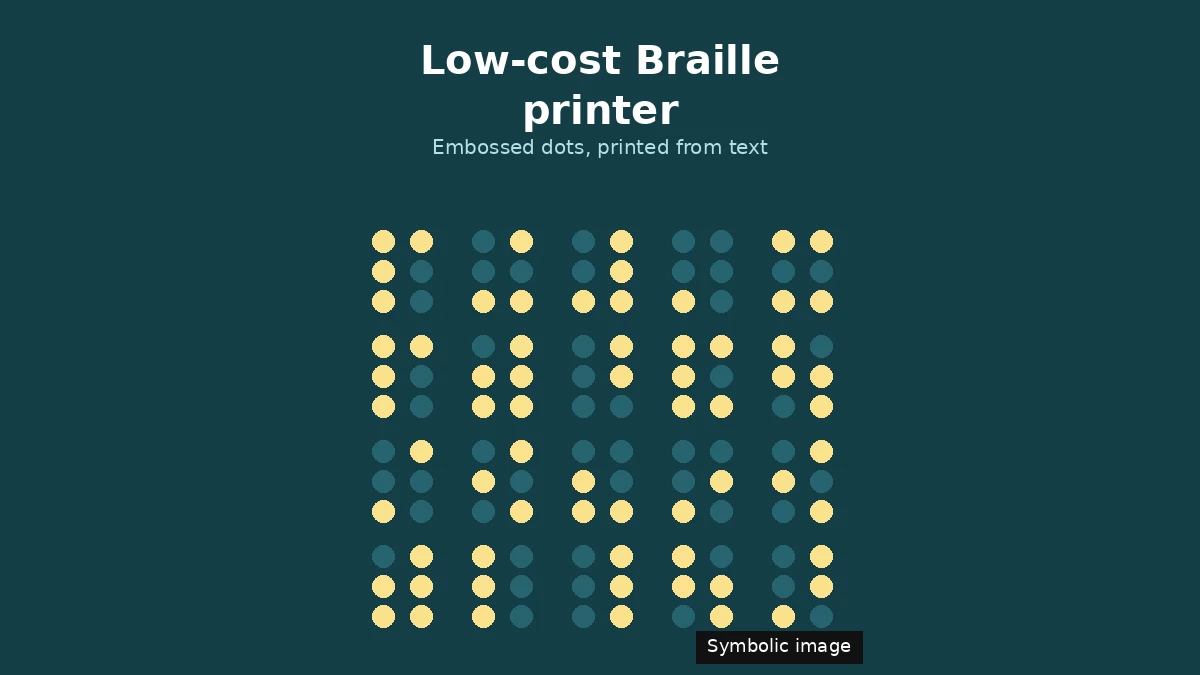
A student group at Chittagong University of Engineering and Technology (CUET) has built a compact Braille printer for Tk 28,000. International Braille printers cost about Tk 500,000.
The printer, named Sync V-1, was developed by a student group called Sync Robotics under the guidance of Professor Md Ahsanullah of CUET's Electrical and Electronic Engineering Department. The team was led by Sourav Tarafdar, a fourth-year student of Electrical and Electronic Engineering. Its other members are Ifaz Hossain, a third-year student of Petroleum and Mining Engineering, and Imam Rashid, a first-year student of Civil Engineering.
The idea came from the difficulties of visually impaired students. Siddharth Mistri, a Bengali Department student at the University of Chittagong, has been visually impaired since birth. He prepares his own notes and study materials and needs a specialised printer to produce Braille. Such printers are very expensive.
Some private organisations import Braille books, and their printing machines cost over Tk 10 million. Ordinary people in Bangladesh have almost no way to print Braille for personal use. Dhaka University once had a Braille printer donated by the Netherlands Government, but it no longer works.
Professor Ahsanullah began considering the problem around 2005. With Jahangir Alam, a Computer Science and Engineering teacher, he researched Bengali Braille technology and published a research paper. He wanted a portable, compact and easy-to-use printer, possibly with voice support and keyboard sounds, so that visually impaired users could edit and print on their own. He said imported printers cost USD 2,500 to USD 5,000 or more. "Our main objective was to make this printer accessible to everyone," he said.
Users type Bengali or English text into dedicated software, which converts it to Braille. They insert paper, and the printer embosses the dots. The device can also print text from PDF and Word files. More languages can be added through software updates.
Two visually impaired students of the University of Chittagong, Siddharth Mistri and Akash Das, tested the device. "We had to write everything by hand," Mistri said. "From that perspective, this is a major innovation for us." "The device is small and lightweight, so it is easy to carry," Das said.
Sync V-1 won the Student-Tertiary, Inclusion and Public Service category at the Bangladesh ICT and Innovation Awards 2026. It competed against 355 projects, of which 118 were shortlisted and nine were named champions across categories. It has been nominated to represent Bangladesh at the APICTA Awards 2026.
The team plans to improve printing speed, add wireless connectivity and support more languages. Another feature could print standard Bengali or English text alongside Braille, which would help students in exams. Moving to commercial production requires partners and investors. "Our goal now is to take it beyond the laboratory and make it available to people as an affordable, accessible product," Tarafdar said.